
The Ancestral Sky
The day we stopped looking up at the stars


The Stargazing Artists
Humans have been keeping track of time by observing the night sky for the past 40,000 years. Research from the universities of Edinburgh and Kent suggest that cave art found in Spain, France, Germany and Turkey, which was previously thought to depict ritualised hunting scenes, is in fact an ancient method of time keeping.
These cave paintings are not only depictions of star clusters but also records of astrological events such as comet strikes. By carbon dating the cave artists’ paints and cross referencing with a planetarium software, researchers were able to see what constellations were in the sky at the time of each of the artworks. Lascaux cave in Dordogne, France, has a scene showing a dying man surrounded by animals and geometric shapes. This is believed to be a commemoration of a comet strike that hit Earth around 15,200 BC.
The findings also suggest that the ancient cave artists knew the night sky was not static and that the stars gradually moved over large expanses of time, a phenomenon known today as the Precession of the Equinoxes. This discovery was previously credited to Hipparchus, an ancient Greek astronomer (I will elaborate on precession later in the article).
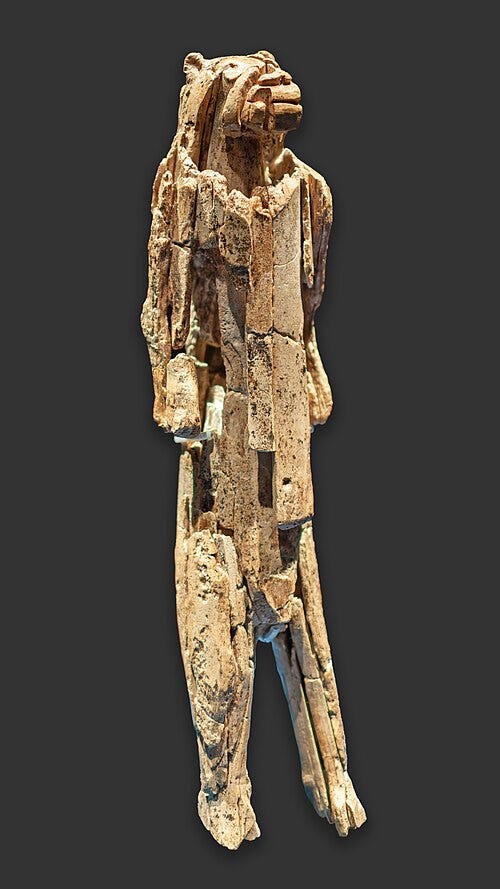
The world's oldest sculpture dating to 38,000 BC, known as the Lion-Man of Hohlenstein-Stadel, discovered in a cave in Germany, is thought to be the earliest depiction of the constellation of Leo. We are now only scratching the surface of the astronomical knowledge of our early ancestors.
The Mesopotamian Astronomers
Over tens of thousands of years, knowledge of the stars was passed down through the generations until the Sumerians and Babylonians began recording patterns and synchronicities between what was happening in the heavens with what was taking place here on Earth. These time obsessed astronomers carefully recorded the shifting energies of each planet as it moved through different parts of the sky. Astrological maps were consulted in times of war, political unrest and for agricultural timings. Such methods of calculating time and predicting future events were harnessed for the advancement of their society. Legends of heroes and gods were eventually attributed to certain star clusters and the concept of what we know today as astrology was born. However, it was not known as astrology at this time; instead it was known as divination by the means of astronomy. For our ancient ancestors, astronomy and astrology were two sides of the same coin.
Over the centuries, calculations of astronomical charts were simplified and by 500 BC, the eighteen constellations of the Sumerian zodiac (3100 BC) became the twelve constellations of the Babylonioan zodiac. A number which was far easier to use in mathematical calculations. These same twelve constellations are used in today’s mainstream astrology which is known as Tropical Astrology. Before the simplification of the zodiac, the 18 constellations of the Sumerian Zodiac were as follows:
The Star Cluster; The Pleiades (in the constellation of Taurus)
The Bull of Heaven (the constellation of Taurus)
The True Shepherd (the constellation of Orion)
The god Enmesarra, The Old One (the constellation of Perseus)
The Shepherd’s Crook (the constellation of Auriga)
The Great Twins (the constellation of Gemini)
The Deceptive Digger; a turtle (the constellation of Cancer)
The Exalted Lion/Great Carnivore (the constellation of Leo)
The Furrow (the constellation of Virgo)
The Scales (the constellation of Libra and the lower part of Virgo)
The Cutter (the constellations of Scorpius and the legs of Orphiucus)
The god Ninurta/Pabilsag (the constellation of Sagittarius)
The Goat-fish (the constellation of Capricorn)
The god Enki/Ea; The Great One (the constellation of Aquarius)
The Tails of the Great Swallow (the western fish of the constellation of Pisces)
The Great Swallow (the constellations of SW Pisces, Epsilon and Pegasi)
The goddess Anunitu (the constellations of NE Pisces and Andromeda)
The Farm Worker (the constellations of Aries, Triangulum and the head of Cetus)

The Ancient Greek Thinkers
It was through ancient Egyptian culture that Babylonian astronomy was brought to the west. The ancient Greeks did not have their own astrological system and greatly modified what they inherited from the Babylonians to align with their worldview. They assigned elements to each of the signs of the zodiac (fire, earth, air and water), planetary rulers (e.g Mars rules Aries), modalities (giving each sign a quality that aligned them to the seasons) and a house system that divided an astrological chart into different areas of life (e.g the sixth house represents daily routines, health and wellbeing). The Babylonians also used houses, but no records have been found of what they represented.
Greek astronomers also abandoned the natural boundaries between each of the constellations which all vary in size and instead gave each a thirty degree segment of the ecliptic (the ecliptic is the path taken by the planets through the constellations). The constellation of Virgo naturally spans forty eight degrees and the constellation of Cancer spans sixteen degrees. This means that the sun takes forty eight days to journey through Virgo and sixteen days through Cancer. But the Greek zodiac that mainstream Tropical Astrology has inherited tells us that the sun ‘takes’ thirty days to travel through each of the constellations.
By the second century AD, astronomers were to come to an unanimous decision that would be the final nail in the coffin for astronomical astrology. The dominant thought among the great ancient Greek thinkers and geo-centrists such as Aristotle was that the Earth was fixed and it was the sun that orbited around it.
The ancient Greek astronomer and mathematician Aristarchus of Samos (c.310-230 BC) figured out that the sun was a star and that the Earth actually rotated while orbiting it. These were extremely unpopular ideas and were even seen as sacrilege at the time.
Greek philosophers and mathematicians did not understand the Precession of the Equinoxes. The astronomer Hipparchus of Rhodes (c.190 - c.120 BC) who was geo-centric had observed that the constellations moved relative to the point of sunrise; but as he did not understand why this was happening he supported the idea of having a fixed point at the Vernal Equinox because in his eyes, the stars were not trustworthy for time keeping. Later in his life he realised that it was the Precession of the Equinoxes that was causing this to happen, but by then the damage was done and the zodiac was superimposed onto a fixed seasonal calendar.
The decision to have a fixed calendar was to allow for a more harmonious system that followed the seasons because timings of the agricultural year such as sowing and harvesting were very important in a world where the Earth was the centre of the cosmos. This was also around the time when the Julian Calendar was created.
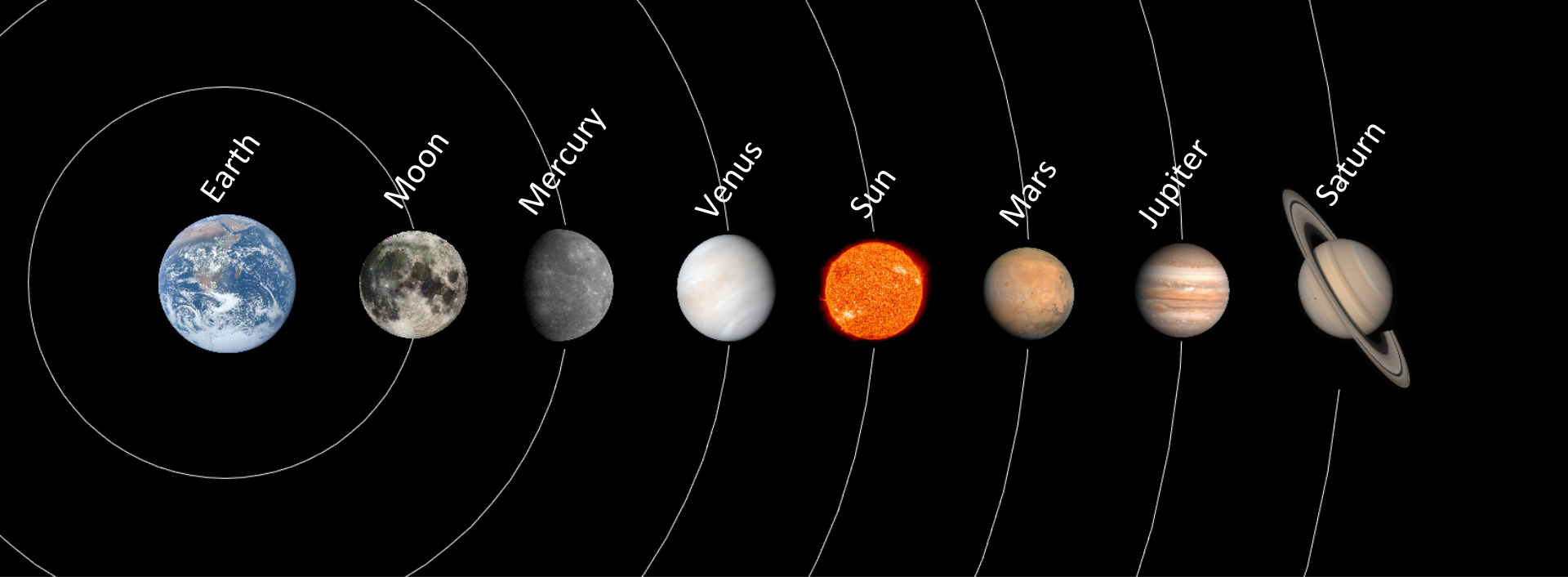
Ptolemy (c.100 - c. 170 AD) a Greco-Roman astrologer, astronomer, geographer and mathematician, agreed with the idea of applying the zodiac signs to the seasons. He and others were of the belief that every year at the Vernal Equinox, the sun would rise at 0 degrees Aries. They were no longer orienting to nature, they were orienting to manmade tables. So 2000 years ago we stopped looking up at the heavens and the zodiac was frozen in time.
The Precession of the Equinoxes
Greek thinkers were unaware that the stars ‘move’ one degree every seventy two years due to the Earth’s wobble (precession) on its axis. Today we know this as the Precession of the Equinoxes. After 2000 years of this backward motion, the sun no longer rises at 0 degrees Aries at the Vernal Equinox. It now rises at twenty four degrees Pisces.
Mainstream Tropical Astrology, a system used by the majority of western astrologers today, finds itself with a discrepancy of up to almost two zodiac signs because it was last accurate in 221 AD. Vedic Astrology gets a little closer to the truth, but still uses thirty degrees for each sign. If astrology is derived from astronomy would you not want a system that lines up with the actual stars?
The 13th Sign
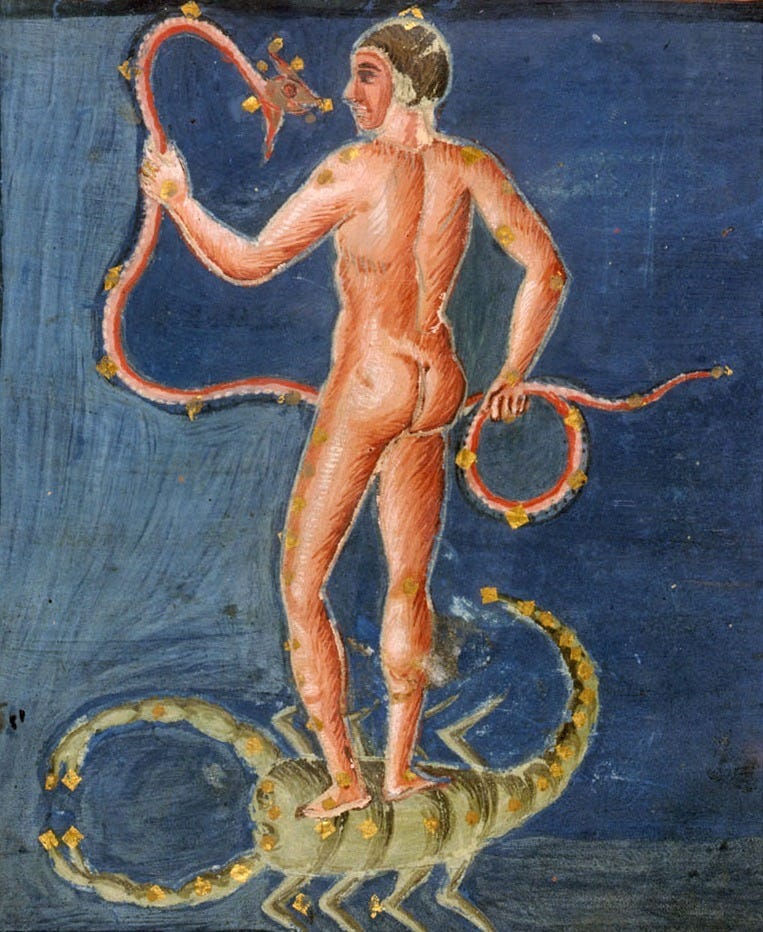
We now find ourselves in quite a predicament and the only way to get out of it is to go right back to the beginning. Astronomical Astrology also known as Constellational Astrology uses the actual size and location of the constellations that sit along the ecliptic. This system uses the real sky in real time just as the ancient astronomers did. Astronomical Astrology incorporates the constellation of Ophiucus who is mentioned in ancient star catalogues. Ophiucus shares the same part of the sky as the constellation of Scorpio and the sun can be clearly seen travelling through it on an astronomy app.
Ophiucus can be found in ancient Greek myth. He is Asclepius, the great god of medicine. He was raised by the centaur Chiron who is known as the wounded healer and who taught Asclepius the healing arts. When he was older, Asclepius healed a snake who in return imparted secret knowledge. This is how his symbol of the snake, entwining a wooden rod, came into being. The symbol of the snake was once the symbol of the healing arts until it was ‘mistakingly’ replaced in the early 20th century with the staff of Hermes, the god of thieves, lying, commerce and passage into the underworld. Known as the Caduceus, this staff has two snakes entwined around it and was adopted by the medical field in America.
Asclepius became so knowledgeable in the healing arts that he was even able to resurrect the dead. This greatly angered the god Zeus who wanted to keep natural order, so Asclepius was shot down with a thunderbolt and placed in the heavens as the constellation of the Snake Bearer. Ophiucus is directly opposite the constellation of Orion the Hunter.

Astronomical Astrology vs Mainstream Astrology
Now this is the part where the astrology deception really becomes clear and you will need some time for this to sink in. The following dates are the actual times the sun spends in each of the constellations. This means that you will likely see you are not born under the astrological sign you always thought you were, unless you were born right at the end of a large constellation and going back twenty four degrees leaves your natal sun in the same constellation. The Ascendant and all of your natal planets will likely be different as well. One degree on the ecliptic equals approximately one day in real time. I have taken these dates from the Capricorn Prometheus software programme (Astronomical Astrology settings).
Aries (21st April - 11 May)
Taurus (11th May - 18th June)
Gemini (18th June - 19th July)
Cancer (19th July - 6th August)
Leo (6th August - 15th September)
Virgo (15th September - 4th November)
Libra (4th November - 23rd November)
Scorpio (23rd November - 6th December)
Ophiuchus (6th December - 19th December)
Sagittarius (19th December - 21st January)
Capricorn 21st January - 15th February)
Aquarius (15th February - 9th March)
Pisces (9th March - 21st April)
Please note that some websites such as Wikipedia use IAU boundaries to calculate these dates and not the ecliptic or midpoints (the middle point between two constellations) which means they are not precise enough for astrology purposes.
You may be asking what all the fuss is about. Why does it even matter whether the true sky held your natal sun in the constellation of Pisces while the zodiac stories you have been brought up with say it was in the constellation of Aries? When man attempts to compartmentalise and control the natural world it never ends well. We have never been as far removed from our natural state of being as we are today. How can you be authentically you if all of your life you have been told that you are one thing while actually being something else entirely? Being told that you are a sea goat (Capricorn) ambitious and logical, but in reality you are a centaur (Sagittarius) adventurous and full of wonder. A very different kettle of fish. The lost potential of a meaningful and inspiring life is unthinkable. You are living a life that is not yours and we are all unknowingly projecting this mirage onto the collective. Even if you know next to nothing about astrology and its archetypes, it is still unconsciously affecting us all.
Mainstream Tropical Astrology is seen as a New Age gimmick, something silly and entertaining and it is also deeply ingrained in today's popular culture. Who doesn't laugh and roll their eyes when they read their daily horoscope? Astrology is no longer seen as the respected science it once was because people unsurprisingly do not resonate with a 2000 year old defunct technology.
When we use the real sky at the exact moment we were born, astrology suddenly becomes healing and self empowering because it is a true snapshot of the heavens at the time of our birth. We bemoan that life does not come with an instruction manual, but what if this is not the case? Is our astronomical natal chart a personal blueprint, our north star? By not knowing are we struggling unnecessarily in life?
For astrology to be seen as a valid scientific discipline we need to return to its astronomical roots. The astronomical accuracy of divining by the stars was paramount for our ancient ancestors. In some situations it was a matter of life or death.
With the technology we hold in our pockets today, no one should be making the mistake of being off by twenty four degrees! A system which has seasonal associations is useless outside of a specific region or hemisphere, but some folks just do not see it. The word ‘astro’ means star, so why haven’t the majority of astrologers who follow the mainstream narrative taken a telescope and gone outside to actually look up at the stars? It is frightening how easily we are programmed with falsehoods and how pride stops us from admitting when we are wrong.
If what I have shared with you today has peaked your interest in the same astronomy and astrology that the ancient Druids would have used then I highly recommend the free planetarium software called Stellarium. If you put in your date of birth it will show you the real sky as it was when you were born. For those of you who are curious about your astronomical natal chart go to Mastering the Zodiac’s free chart calculator.
If you have any questions about true sky astrology then please do not hesitate to ask me. My daughter has been studying astronomical astrology and reading charts for over twelve years so she will be able to answer your questions if I am unable to. Over the past decade, more and more people have been waking up to the truth of the real sky. Once your eyes are opened to the wisdom of the ancient skygazers there is no going back.
Brightest blessings,
Elissa
Recommended Reading
The 13th Sign by Dr Dani Inman (2025)
Gate & Key by G. Desiree Fultz NLP (2018)
Starlore of all Ages by William Tyler Olcott (1911) Free on archive.org
Star Names and their Meanings by Richard Hinckley Allen (1936) Free on archive.org
Recommended Websites
masteringthezodiac.com (free weekly newsletter and online astrology software)
sumerianastrology.com
oneskyastro.com
drdani.com
All of these true sky astrologers can also be found on Youtube.
Ahh this is great, the one i have been waiting for! :) Had you not opened my eyes to this a few years ago, id still be lying to myself now hahaa! I absolutely resonate with cancer and not leo, i checked it out on Stellarium on the actual day of my birthday, and there it was in plain sight, the sun was in cancer. In very many ways i have felt more truly aligned with myself and i thank you once again for enlightening me to such reality x
That was fascinating, thanks, Elissa, and thank you for the links, too... According to astronomical astrology, I am well and truly a Virgo, not a Libra, which makes my love of spreadsheets, lists, project management frameworks, etc., much more understandable LOL!